Blog

“Sondra Perry’s First Solo European Show Engulfs Visitors in Turner’s ‘The Slave Ship'”

This announcement caught my eye because I was intimately familiar with the painting, The Slave Ship by JMW Turner.  I used it in a PowerPoint in US History when we studied Middle Passage and the slave trade.  Words can only go so far. A teacher will stretch to provide meaning in the face of the ineffable.

 “.. The Slave Ship  (was) originally titled “Slavers Throwing overboard the Dead and Dying — Typhoon coming on. Sondra Perry, an African American artist who uses open source digital software to create video installations, takes the title of her first solo European show from Turner’s painting.”

Typhoon Coming On by Sondra Perry can be seen at the Serpentine Sackler Gallery in London until May 20.

Hyperallergic

Slave-ship-720x541


A glimmer of hope for poets

The blog site Submittable sympathizes with you – even a Genius Award winner took 30 years to get a poem to be accepted by The New Yorker.   Another widely published and honored poet got two poems accepted by Poetry in a ten-year stretch.  “Partly, this is a numbers game. Rattle, for instance, provides submissions statistics on their website—they receive 120,000 poems per year, of which they only publish 250.”  I sympathize with you also.  Keep trying.  “So with the unreachables out of the way, where can poets and writers find venues for their work?”  Submittable has a list of 10 possible alternatives to Poetry, Threepenny Review or The New Yorker.  Number 11, send your poetry to Event Horizon.

beachcombing

As I’m sure I’ve told you, I am a shameless scavenger of the public domain.  I discovered a newsletter, The Public Domain Review, and was delighted to find my first issue today.  Included here is a shared print just for the hell of it, Fukami Jikyu In Moonlight.  It is a woodblock print by Tsukioka Yoshitoshi, ca 1887.

fukami in moonlight

“21st Century Goya”

President George W. Bush is getting extremely good press as a painter.  He is represented by a gallery, Mnuchin and Mnuchin in NYC.  Columnist William Powhida of Hyperallergic reports on Bush’s show, Cowards:

Bush’s title, Cowards, bluntly refers to his own public statements about deposed president Trump and the people that enabled his catastrophic presidency. He also hopes that his commitment to painting these liars, criminals, cheaters, abusers, traitors, and bystanders might serve as a form of penance for his own errors in judgment. The stunning candor of Bush’s new paintings may very well help establish his reputation as a 21st-Century Goya, capable of uncovering the humanity in monsters like John Bolton, Mike Pence, Steve Bannon, Robert Kelly, Donald Trump, Jr., Ivanka Trump, Jared Kushner, and Mike Pompeo through compassionate looking. It is a testament to Bush’s faith in forgiveness that he would dedicate almost ten years to painting indicted war criminals.

Hyperallergic

SeaTac Pdx Art Axis

The SeaTac Pdx Art Axis is not actually “a thing” at the moment, other than a figment of my imagination. But it should be and Interstate 5 makes it so.  This art community is an integrated whole defined by geography, demography, history and cultural identity.

Most large American cities have the critical mass to comprise their own art communities.  And there are noticeable art zones outside this seemingly arbitrary bulls eye.  So I need to make myself clear.

The Puget Sound metropolitan area, predominated by Seattle and Tacoma, is geographically removed from Portland by roughly 110 miles of forests, Cascade foothills, intermittent farming communities and small-ish population centers.  These two distinct centers are rigidly connected by I-5, as are hundreds of communities, large and small, from Vancouver, BC to Tijuana.

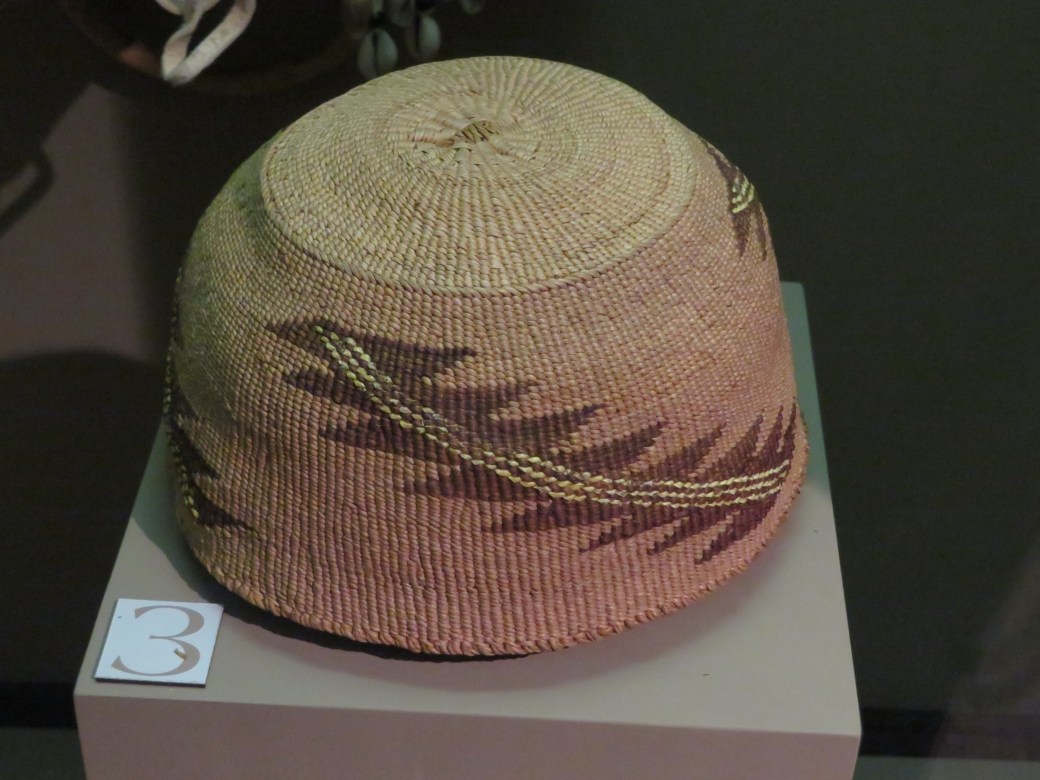
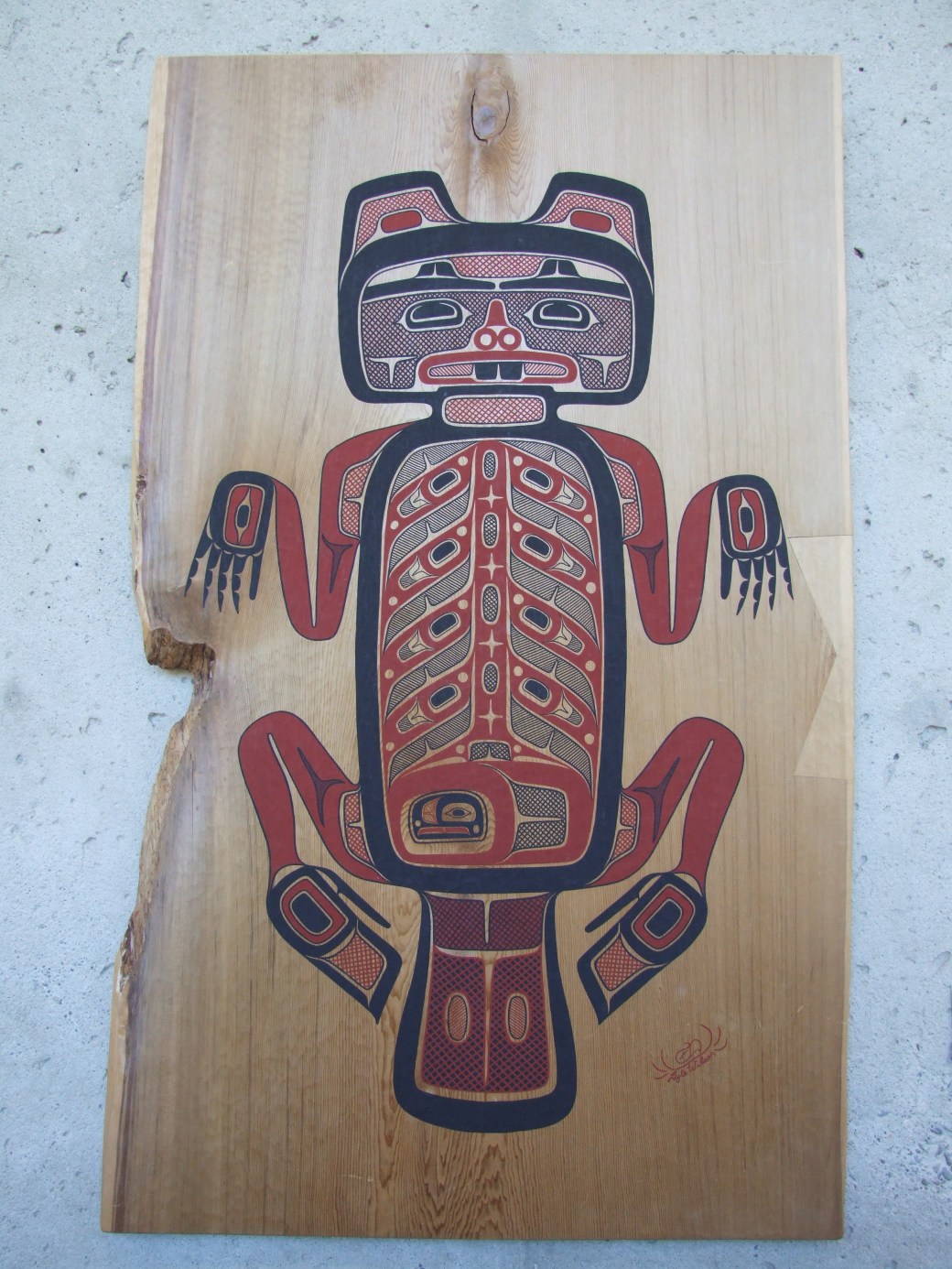
Pacific Northwest I-5 is the boundary between two ancient and significant art and cultural regions.  The north  coast art traditions of decorated lodge houses, “totem poles”, masks, bentwood boxes and formline design are familiar in the popular imagination. The peoples of the Columbia Plateau have artistic and craft traditions equally ancient and widespread which are literally woven or etched into their objects of everyday life, and their trade goods.  These separate regions traded with each other and developed their own relationships with their special bodies of water and their special climate zones.

By the mid-1700’s European influence was considerable.  The effects weren’t limited to the Pacific Northwest. Nonetheless those effects – drastic depopulation from disease and the encroachment upon, and appropriation of, land and other crucial economic resources – were cataclysmic for the indigenous populations.

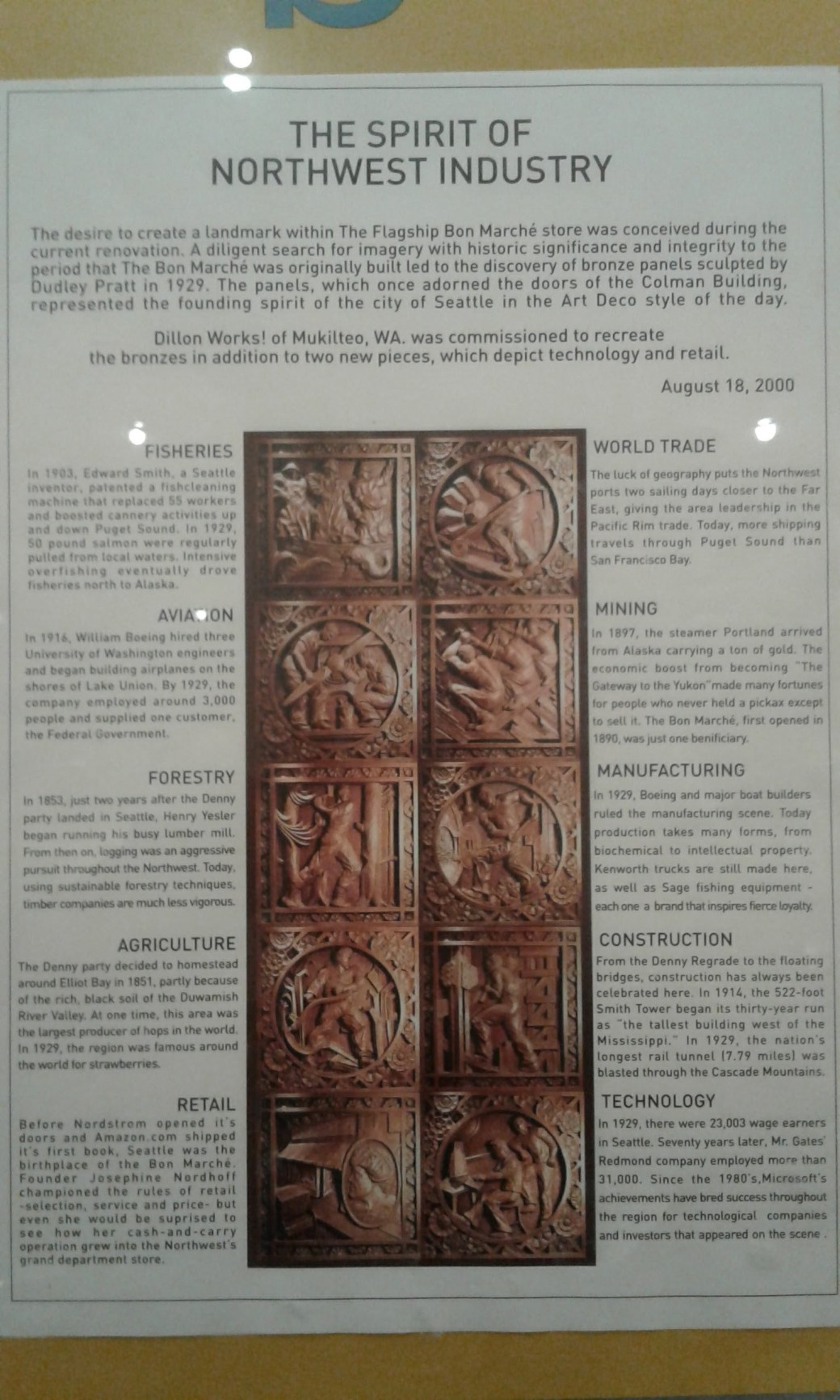
For the Europeans, fortunes were made and new lands were settled.  “Old money” around the SeaTacPdx Art Axis is from trade and transport, logging, fishing, and agriculture.  Old immigrant  stock and newer transplants alike celebrate these rugged pioneer origins.  The WPA murals or other commissioned artworks (or monuments  like Timberline Lodge) have left us heroic depictions of these efforts.  Columbia Plateau beadwork and basketry also adopt much of this iconography by the late 19th century.

Anecdotally, Seattle, Tacoma and Portland are literally a “visit to grandma” away from each other.  The job market and a close network of personal ties bind the area.  Colleges and universities from one end of the axis to the other are considered local and pose no emotional barrier in that regard for prospective undergraduates.

There are remarkable museums and galleries in all three cities and this is not unexpected.  The important point is, for example, that the Hot Shop glass-making facility and its parent Museum of Glass comprise  an important venue for exhibition and workshops for all glass artists in the Axis.  These local and overlapping hot-spots across the genres create the critical mass for this art region.

So what?  I don’t presume to have the inspiration for a PhD thesis here. It’s just a convenient structure for me.  I don’t think it’s a disparagement to say something like “Well, it ain’t New York” because what it is is considerable, cohesive and unique.
spirit of nw indusformline creature woodIMG_0456

Today is Piano Day in Portland!

March 29.  Almost missed it:

How does Piano Day work in Portland?

On March 29, there will be six locations in the Portland Metro area where you can hear the piano played by local pianists of all ages on some of the region’s best pianos. The choice of music is up to the performer and there are no restrictions on what can be played. The events are free to the public, but each performer raises funds from the community with a minimum goal of $10 per minute played. A robust software platform is  in place to help manage the peer-to-peer fundraising process. The funds raised are used to support the educational programs of Portland Piano International. 

Piano Day in Portland

The mark of a true artist

I was moved by comments in this notice about the current gloom and frustration of artists as a community since November.  Rather than parse it, I offer the entire notice here from portlandart.net :

After the 2016 presidential election the constant stream of intolerance and hate has made it difficult for many artists to produce work (and have been collecting pitchforks and torches instead). Still, the mark of a true artist is they need not a vocational requirement to make art, its simply what they do. Storm Tharp is one of those artists and he has been busy. This work, provides the viewer room to breathe as well as vent… a series of large scale prints, it is very different from anything we have seen from him before, though the lumpy forms do evoke his sculpture… recalling the work of Morris Louis and Ellsworth Kelly it is surprisingly Apollonian. In particular I like the way the text based work melts words into form… as the shape of meaning can be either generous or oppressive Tharp lets the words sing and sting without being oppressive. 

Ma’at Mons | February 28 – March 31
First Thursday Reception: March 1, 6-8PM
PDX Contemporary
925 NW Flanders